


The founders who scaled engineering teams 3x without opening a new office didn’t get lucky — they built their entire hiring strategy around work from home jobs before their competitors figured out the math.
Work From Home Jobs Unlock a Talent Pool Your Competitors Can’t Touch

Geographic hiring is a self-imposed constraint. When you limit recruitment to a 30-mile radius around your office, you compete against every funded startup, FAANG satellite office, and legacy enterprise in that metro. Work from home jobs dissolve that constraint entirely.
Stripe proved this at scale. Before their remote-first engineering push, they recruited from a handful of elite university corridors. After opening work from home jobs globally, they hired senior engineers from Lagos, Warsaw, and Medellín — engineers who built payments infrastructure for telecoms and banks that processed more transactions per day than most U.S. fintechs see in a year. That operational depth doesn’t exist in San Francisco at the salaries a Series A company can offer.
The ROI calculation is direct: a principal engineer in Austin costs $210,000–$240,000 total compensation. The same skill profile in Kraków or Bogotá costs $80,000–$110,000. You’re not buying inferior talent. Platforms like Toptal and Arc.dev run technical screens that reject over 95% of applicants. The engineers who pass those screens and accept work from home jobs in Eastern Europe or Latin America do so because remote work gives them lifestyle leverage — not because they lack options.
At Series A, your engineering dollars are finite. Work from home jobs let you hire three senior engineers for the burn rate of one local hire. That’s not a marginal efficiency gain. That’s a structural advantage that compounds every sprint.
The Productivity Data on Work From Home Jobs Kills the “Collaboration” Objection
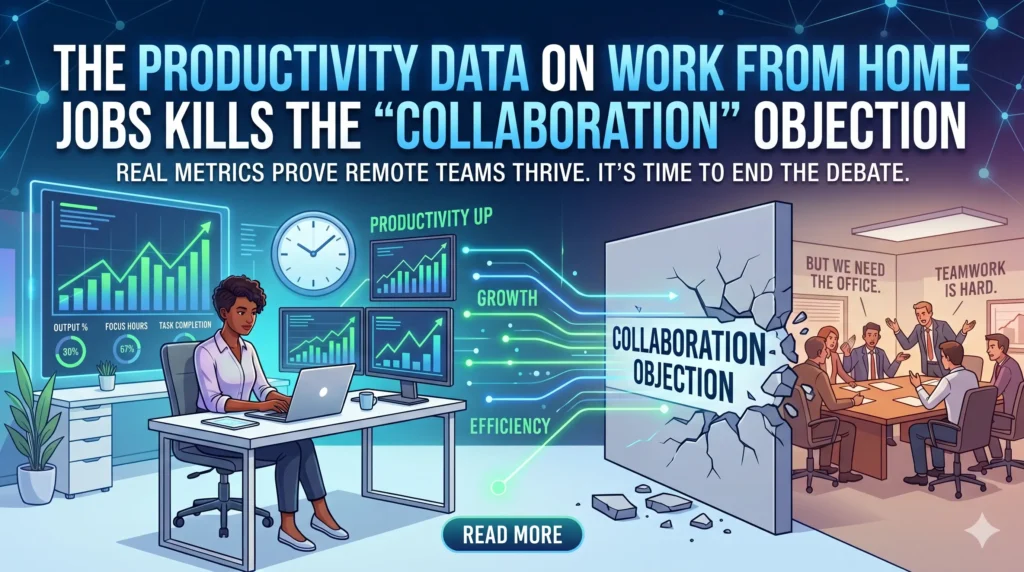
Every skeptic raises the same objection: remote workers don’t collaborate well. The data says the opposite, and founders who ignore it make expensive hiring decisions based on sentiment.
Stanford economist Nicholas Bloom tracked 16,000 employees across two years and found remote workers produced 13% more output per hour than their office counterparts. That’s not a soft metric — it’s measured output on identical tasks. The driver wasn’t motivation. It was elimination of commute fatigue, open-office interruption cycles, and performative face-time culture.
GitLab runs a 2,000-person company across 65 countries with zero offices. Their engineering velocity — measured by merge request throughput and deployment frequency — consistently outperforms industry benchmarks published by DORA (DevOps Research and Assessment). GitLab attributes this directly to async-first work culture enabled by work from home jobs. Every decision gets documented. Every technical discussion creates a permanent record. Onboarding new engineers takes days, not weeks, because the institutional knowledge lives in writing.
The collaboration objection also misunderstands where collaboration actually breaks down. Bad collaboration comes from unclear ownership, poor documentation, and absent process — problems that exist equally in offices. Work from home jobs force founders to fix the underlying problems. You write clearer specs. You define ownership explicitly. You build decision-making frameworks that don’t require a hallway conversation to execute. Those habits make your company faster regardless of where your team sits.
Work From Home Jobs Compress Your Hiring Timeline When Speed Is Everything
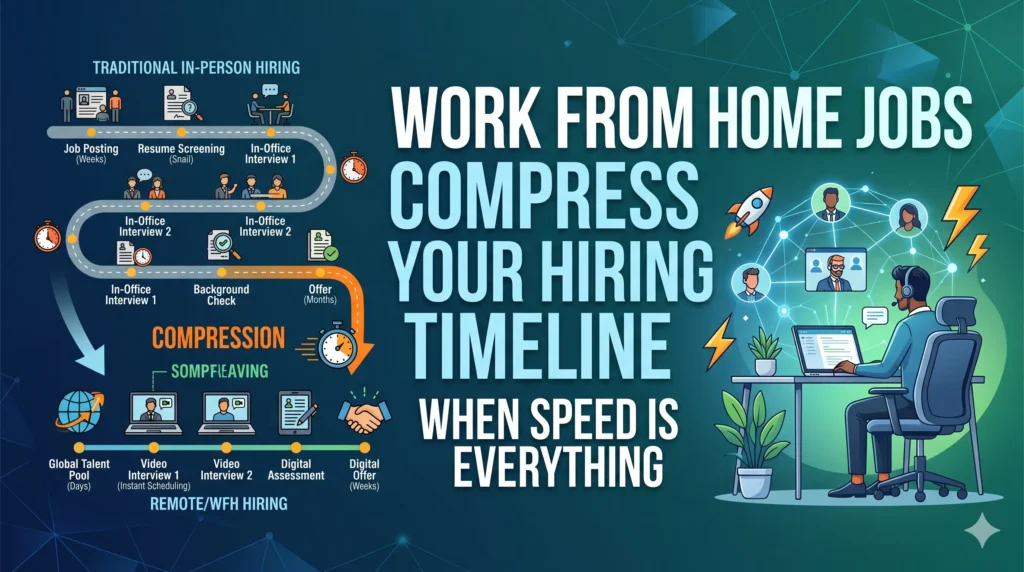
Series A companies don’t have 90-day hiring cycles. You have a roadmap to hit before your next raise, and every open role costs you velocity.
The traditional local hiring pipeline looks like this: post a job, wait three weeks for applications, schedule on-site loops across three weeks, extend an offer, wait two weeks for a decision, then lose the candidate to a competing offer because your process took too long. Eight to twelve weeks minimum, assuming no restarts.
Work from home jobs compress every stage. Async interviews replace synchronous scheduling nightmares. A technical founder in Delhi can run a skills screen with a candidate in São Paulo without coordinating time zones for a live call — send a structured async video response prompt, evaluate it on your schedule, move forward or decline within 24 hours. Companies like Loom, Willo, and Karat have built entire assessment infrastructure around this workflow because the demand from remote-first teams is real and growing.
Remote-first companies also see higher offer acceptance rates. A 2023 LinkedIn Workforce Report showed that job postings advertising work from home jobs received 2.8x more qualified applications than equivalent on-site roles at the same salary band. Candidates self-select hard for remote. When they find a role that fits, acceptance rates climb because they’re not trading off commute time or relocation risk.
Speed compounds. If you close engineering roles 40% faster because you run work from home jobs, and each closed role accelerates product velocity by two sprints, you hit your Series B milestones earlier. Earlier milestones mean better leverage in your next term sheet.
Building Work From Home Jobs Infrastructure That Actually Scales
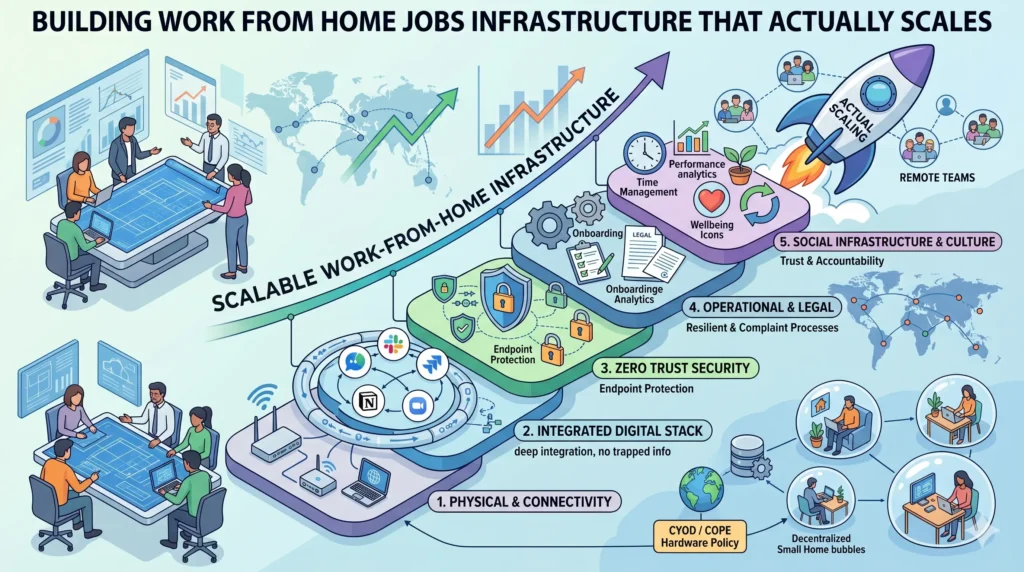
The founders who fail with distributed teams don’t fail because remote work doesn’t work. They fail because they run remote teams with office-era management assumptions.
The infrastructure layer for scalable work from home jobs has three non-negotiable components.
Communication architecture. Async-first means every synchronous meeting earns its place. Default to written updates in a shared system — Linear for engineering, Notion or Confluence for documentation, Slack only for time-sensitive blockers. Loom replaces 80% of status calls. The goal isn’t fewer conversations. It’s conversations that produce durable artifacts instead of fading memories.
Compensation frameworks. Pay for the role, not the location — or pay location-adjusted with full transparency. Buffer publishes their entire salary formula publicly. That transparency eliminates the resentment that corrodes remote team culture when engineers in different cities discover pay disparities through informal channels. Your work from home jobs need a compensation policy that survives a full team meeting.
Performance measurement. Remote work exposes bad management faster than office work because you can’t substitute presence for results. Ship a working OKR system before you scale work from home jobs past ten people. Use DORA metrics for engineering: deployment frequency, change failure rate, mean time to recovery. When you measure outputs instead of inputs, work from home jobs stop being an experiment and become your default operating model.
Automattic — the company behind WordPress — runs 1,900 employees across work from home jobs globally and generates over $400 million in annual revenue. Their management philosophy: trust by default, document everything, measure outputs ruthlessly. The infrastructure investment they made in 2012 is the reason they scale today without the overhead of a physical footprint.
Work from home jobs aren’t a concession to candidate preferences — they’re a leverage mechanism that lets a 40-person Series A company out-hire, out-execute, and out-pace competitors running bloated local teams. Build the infrastructure correctly, and your next hire closes faster, costs less, and ships more than anything you’d find within driving distance of your office.
Written by fashionhub4u.com