fashionhub4u.com

vikasmadaan820@gmail.com

Why Party Wear Dresses Still Win the Room in a World of Fast Fashion

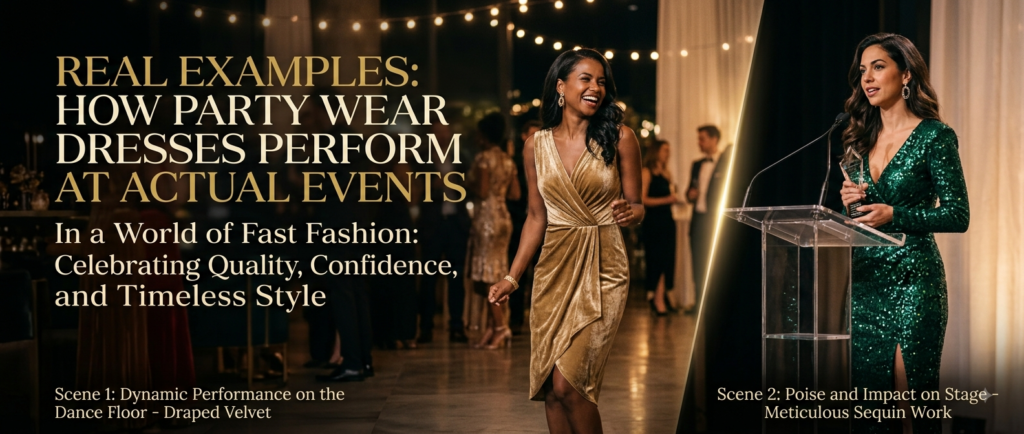
A single well-chosen party wear dress converts a forgettable evening into a memorable one faster than any outfit built from separates. The Case for Party Wear Dresses Over Mix-and-Match Outfits Buying separates means buying two decisions: a top and a bottom that both have to work alone and together. Party wear dresses collapse that into one decision. You try it, it fits, you’re done. That’s not a minor convenience — it’s the difference between fifteen minutes of getting ready and an hour of second-guessing a blazer-and-trouser combination in the mirror. There’s also a fit-and-finish argument. Designers build party wear dresses as a single silhouette from the start, so the proportions between waist, hem, and neckline are intentional rather than assembled after the fact. A sequined bodycon dress or a flowing chiffon gown is engineered to move a certain way under lights, which is exactly the environment most parties happen in. Separates rarely get that same design attention because each piece has to be versatile enough to pair with other items in a wardrobe — versatility and drama are different goals, and drama is what a party calls for. The category also solves a real logistics problem: packing for travel. One party wear dress folds into a fraction of the space that a jacket, blouse, skirt, and accessories combination takes up, and it eliminates the risk of forgetting one piece of a coordinated look. Frequent travelers and people attending back-to-back events — weddings, launch parties, holiday dinners — treat this as a genuine efficiency gain, not just a style preference. Party Wear Dresses Deliver Better Return on a Fixed Budget Cost-per-wear is the honest way to evaluate any clothing purchase, and party wear dresses tend to outperform separates on this metric when the math is done properly. A mid-range party dress priced at $80–150 can be restyled across five or six events using different shoes, jewelry, and outerwear, pushing cost-per-wear below $25. A separates-based outfit built to the same standard of polish usually requires purchasing a top, bottom, and often a third layering piece, and each of those items needs to be replaced or refreshed independently as trends shift. There’s a resale angle too. Party wear dresses in classic silhouettes — the little black dress, the wrap dress, the column gown — hold resale value better than trend-driven separates because the demand pool for “one dress that works for parties” is larger and steadier than the demand pool for a specific colored blazer from a specific season. Consignment platforms consistently show higher sell-through rates for recognizable dress silhouettes than for individual separates, which effectively lowers the real cost of ownership for anyone who resells or donates clothing after a season or two. Budget-conscious shoppers also benefit from the rental market, which has matured significantly around party wear dresses specifically. Renting a statement dress for a single event costs a fraction of buying it outright, and rental catalogs are dominated by dresses rather than separates because dresses photograph better as a complete look and are simpler to size and ship as one item. That infrastructure didn’t build itself around separates — it built itself around the dress category because the economics favored it. When it comes to celebrations, party wear dresses are often the first thing people think about while planning their outfit. The popularity of party wear dresses has grown tremendously, as they combine comfort, glamour, and versatility in a single garment. Whether it’s a wedding, birthday bash, or festive night out, party wear dresses instantly elevate a look, making the wearer feel confident and celebration-ready. Today, party wear dresses come in countless styles, fabrics, and price points, making them accessible to everyone regardless of budget or body type. One reason party wear dresses remain a wardrobe favorite is the sheer variety available in the market. From bodycon party wear dresses that hug the silhouette to flowy A-line party wear dresses perfect for dancing the night away, there is truly something for every occasion. Sequin party wear dresses are especially popular for New Year’s Eve and festive parties, while pastel-toned party wear dresses work beautifully for daytime celebrations like bridal showers or garden parties. This diversity ensures that party wear dresses can be customized to match personal style, body shape, and the mood of the event. Fabric selection is another crucial factor that defines the quality and appeal of party wear dresses. Premium party wear dresses are often crafted from satin, velvet, or georgette, giving them a luxurious drape and finish. Embellished party wear dresses, featuring embroidery, beadwork, or lace, tend to stand out in a crowd and are frequently chosen for milestone celebrations. Shoppers looking for party wear dresses online will notice that fabric quality significantly impacts both the price and the overall look, making it an important consideration before purchase. Affordability and accessibility have also transformed how people shop for party wear dresses. E-commerce platforms now offer an extensive range of party wear dresses across different price brackets, allowing shoppers to find designer-inspired party wear dresses without breaking the bank. Many brands also offer plus-size party wear dresses and petite party wear dresses, ensuring inclusivity across body types. This accessibility has made party wear dresses one of the most searched and purchased categories in women’s fashion, especially during festive and wedding seasons. In conclusion, party wear dresses continue to dominate the fashion landscape because they perfectly balance elegance, comfort, and self-expression. Whether shopping for classic party wear dresses or trendy, statement-making party wear dresses, the options available today cater to every taste and occasion. As fashion trends evolve, party wear dresses will undoubtedly remain a staple choice, offering endless possibilities for anyone looking to make a lasting impression at their next celebration. Real Examples: How Party Wear Dresses Perform at Actual Events Look at wedding season data from bridal party retailers: bridesmaid dresses, a subcategory of party wear dresses, are purchased and worn an average of 1.3 times before storage, yet satisfaction scores from buyers remain high because

Why Party Wear Dresses Still Win the Room in a World of Fast Fashion Read More »
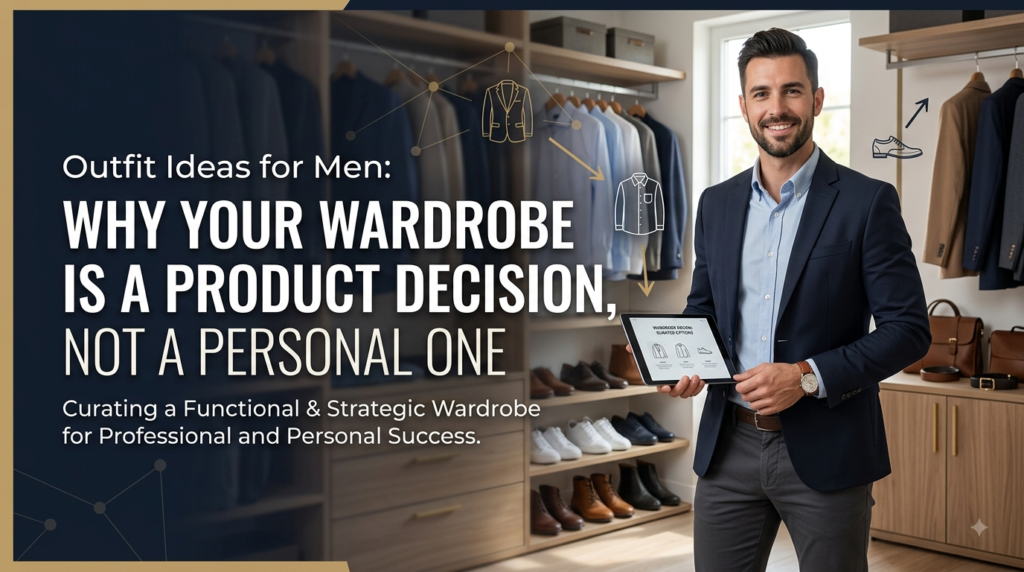
Outfit Ideas for Men: Why Your Wardrobe Is a Product Decision, Not a Personal One

A founder who ships a broken UI apologizes for thirty seconds; a founder who shows up in a wrinkled t-shirt to a term sheet meeting pays for it in every meeting after that. You already know how to evaluate ROI on ambiguous inputs — you do it with hiring, with GTM spend, with which feature to cut. Clothing deserves the same treatment. Good outfit ideas for men aren’t about vanity; they’re a low-cost, high-leverage signal that changes how investors, candidates, and customers read you before you say a word. Below are four concrete, testable moves, not style theory. say a word. Below are four concrete, testable moves, not style theory. Most outfit ideas for men floating around the internet are written for people with unlimited free time: seasonal lookbooks, twelve-step “capsule wardrobe” guides, influencer hauls. None of that maps to a founder’s actual constraints — a ten-minute morning, a calendar full of context switches, and zero tolerance for decisions that don’t compound. The outfit ideas for men in this article are filtered for exactly one thing: does this reduce decision time while increasing signal quality. If a suggestion fails that test, it’s cut. 1. Build a Uniform, Not a Wardrobe Every hour spent deciding what to wear is an hour not spent on your roadmap. The fastest founders solve this the way they solve config sprawl: they standardize. A uniform means picking two or three interchangeable outfit ideas for men that work across 80% of your week — investor calls, all-hands, casual dinners with a co-founder — and repeating them. Steve Jobs’ black turtleneck gets cited too often, but the underlying logic holds up: decision fatigue is a real cost, and clothing decisions compound daily in a way code reviews don’t. A workable Series A uniform: Rotate three shirts, two trousers, one jacket. That’s six real outfits from five items, and you never touch the “what do I wear today” decision again. Test it for two weeks and track how much faster your mornings move — this is the same instrumentation instinct you’d apply to a checkout funnel. 2. Fit Beats Price Every Time Founders overspend on brand names and underspend on tailoring, which is backwards. A $60 shirt that fits your shoulders and doesn’t balloon at the waist reads as more competent than a $400 shirt that doesn’t. The data on this is consistent across retail and behavioral research: people extrapolate competence and trustworthiness from visual coherence, and fit is the single biggest driver of whether an outfit looks “coherent” versus “borrowed.” A jacket that pulls across the back, sleeves that swallow your hands, or trousers pooling at the ankle undercut everything else you’re wearing, regardless of the label sewn inside. Practical fix: find one tailor near your office and use them the way you use a code reviewer — as a standing checkpoint, not a one-off fix. Bring in three items you already own (one blazer, one shirt, one trouser) and get them taken in. Total cost is usually under $150 and the improvement is immediate and visible in every photo, every pitch deck team page, every LinkedIn headshot going forward. This is the single highest-ROI move in this article. If you do nothing else, do this. 3. Context-Switch Your Outfit Like You Context-Switch Your Pitch You don’t pitch a Series A partner the same way you pitch a design partner customer. Your outfit should context-switch the same way. Three scenarios, three specific outfit ideas for men that avoid both extremes — the hoodie-as-rebellion cliché and the over-suited banker look that reads as out of touch at a startup: The mistake most technical founders make is wearing the same outfit to all three. It’s not wrong exactly, but it’s a missed signal — the same way sending an identical cold email to every persona is a missed signal. Match the outfit to the room the way you’d match messaging to a segment. 4. Buy Fewer, Better Pieces — Then Stop Shopping Founders who treat their wardrobe like a backlog end up with forty items and nothing to wear, the clothing equivalent of feature bloat. The fix is the same discipline you’d apply to a product roadmap: cut ruthlessly, then freeze scope. A tight, high-ROI base layer for outfit ideas for men that actually get worn: That’s 13 items producing dozens of combinations, all interchangeable, all fitted by the tailor from step two. Total spend, buying mid-range and prioritizing fit over brand, typically lands between $800 and $1,400 — less than most founders spend on a single conference sponsorship, and it pays out in every meeting for the next three years. Once the base layer is built, stop. Adding a fourteenth shirt has near-zero marginal value; replacing a worn-out item does. Treat your closet like a lean product: ship the core, iterate slowly, resist scope creep. None of these outfit ideas for men require a stylist, a personal shopper, or a weekend lost to malls. That’s the point. The best outfit ideas for men for a Series A founder are boring on purpose — boring enough that nobody in the room remembers what you wore, only that you looked like you had it together. Memorable outfits are for people whose job is to be looked at; your job is to be trusted, and trust is built from consistency, not novelty. 5. Where Founders Get Outfit Ideas for Men Wrong The failure mode isn’t laziness — it’s sourcing. Founders pull Outfit Ideas for Men from the same three places everyone else does: a menswear subreddit, an influencer’s affiliate links, or whatever a department store mannequin is wearing that week. None of those sources are optimized for your constraints, so the outfit ideas for men that come out of them are optimized for someone else’s life — someone with a stylist, a bigger closet budget, or a job where being noticed is the goal instead of a side effect. Better sourcing looks like this: pick two or three men whose

Outfit Ideas for Men: Why Your Wardrobe Is a Product Decision, Not a Personal One Read More »

Fashion Tips for Men: Why Your Wardrobe Deserves the Same ROI Thinking as Your Product Roadmap

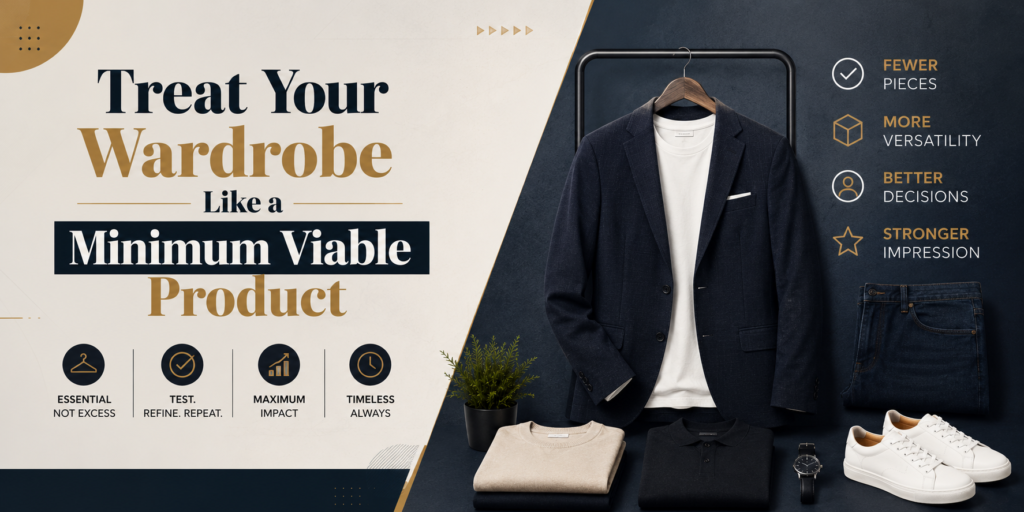
Investors judge your seed deck in ninety seconds, and people judge you in seven — so the fashion tips for men who run companies matter more than most founders admit. Fashion Tips for Men can help every man improve his appearance, confidence, and personal style without spending a fortune. Good fashion is not only about wearing expensive clothes; it is about choosing outfits that fit well, match your personality, and suit the occasion. With a few simple Fashion Tips for Men, you can create a stylish and confident look every day. One of the most important Fashion Tips for Men is to focus on the right fit. Clothes that are too loose can make you look untidy, while extremely tight clothes may feel uncomfortable and restrict movement. Shirts, T-shirts, trousers, and jackets should fit your body comfortably. Well-fitted clothing can instantly make even a simple outfit look more polished. Another useful Fashion Tips for Men is to build a wardrobe with basic and versatile colors. Black, white, navy, grey, beige, and olive are easy to combine with different outfits. A collection of simple shirts, plain T-shirts, jeans, chinos, and formal trousers can provide many outfit combinations. Neutral colors also make it easier to create a clean and sophisticated appearance. Choosing the right footwear is another important part of Fashion Tips for Men. Shoes can strongly influence your overall appearance. Sneakers are ideal for casual outfits, loafers can create a smart-casual look, and formal shoes work well with suits and office clothing. Keeping your footwear clean and in good condition is just as important as choosing the right pair. Accessories can also improve your style, which is why they are an essential part of Fashion Tips for Men. A good watch, simple belt, sunglasses, wallet, or minimal bracelet can add personality to an outfit. However, avoid wearing too many accessories at once. The goal should be to complement your outfit rather than make it look overloaded. Seasonal dressing is another valuable point among Fashion Tips for Men. During summer, choose lightweight and breathable fabrics such as cotton and linen. In winter, layering can help you stay warm while looking stylish. Jackets, sweaters, hoodies, and coats can be combined with basic outfits to create a fashionable winter appearance. Personal grooming should also be included in Fashion Tips for Men because clothing alone does not complete your appearance. Clean hair, a well-maintained beard or a clean shave, fresh breath, neat nails, and good personal hygiene can significantly improve your overall presentation. A well-groomed man usually looks more confident and put-together. Understanding the occasion is one of the most practical Fashion Tips for Men. An outfit suitable for a college day may not be appropriate for a business meeting or wedding. Casual occasions allow T-shirts, jeans, and sneakers, while formal events require shirts, trousers, blazers, or suits. Dressing appropriately shows confidence, awareness, and respect for the occasion. A final point in Fashion Tips for Men is to develop your own personal style. Fashion trends change frequently, but personal style can remain consistent. Experiment with different colors, patterns, fits, and combinations to discover what looks best on you. Confidence is the most important accessory, so wear clothes that make you feel comfortable and authentic. Treat Your Wardrobe Like a Minimum Viable Product A founder wouldn’t ship a product with fifty half-built features and zero polish. Yet most technical founders build a wardrobe exactly that way: forty t-shirts, three blazers that don’t match anything, and a pair of dress shoes bought once for a wedding. The better approach mirrors product strategy. Pick a tight core loop — two or three trousers, four shirts, one blazer, one pair of versatile shoes — that all combine cleanly with each other. This is the MVP version of fashion tips for men: fewer components, higher combinability, faster decisions every morning. Founders who apply this constraint report the same benefit they get from a lean tech stack: less maintenance, fewer failure points, faster iteration. The math backs this up. A ten-item core wardrobe built for interoperability produces roughly forty usable outfit combinations. A forty-item wardrobe with no interoperability produces maybe fifteen, because most pieces don’t pair with anything else. Fewer SKUs, more output — the same logic that makes a lean codebase easier to ship than a bloated one. Fit Beats Price Every Time You Meet an Investor Founders will drop six figures on a Series A term sheet negotiation but balk at spending forty dollars on tailoring. That’s backward. A three-hundred-dollar suit tailored to fit outperforms a fifteen-hundred-dollar suit bought off the rack and left untouched. Fashion Tips for MenFit is the highest-leverage, lowest-cost lever in fashion tips for men, and it’s the one founders skip most often because it requires an extra thirty-minute appointment instead of a single checkout click. Three fit checks catch ninety percent of problems: shoulders should end exactly where your arm bends, sleeves should stop at the wrist bone, and trousers should break just once at the shoe. Any tailor can fix all three in one visit for under fifty dollars. Compare that cost to a single missed investor meeting because a blazer looked borrowed from a taller sibling — the tailoring appointment wins on ROI by an order of magnitude. Founders traveling for fundraising rounds should build this into the calendar the same way they schedule pitch rehearsals: one tailoring pass before a roadshow, not after landing in the wrong city with an ill-fitting suit and no time to fix it. Build a Uniform, Not a Rotation Steve Jobs didn’t wear the black turtleneck because it looked good — he wore it because it removed a decision. Technical founders make thousands of decisions daily, and clothing shouldn’t be one of them. A uniform approach solves this directly: pick one dependable outfit formula (dark jeans, crisp shirt, quality sneakers, structured jacket) and repeat it with minor variation. This is the single most repeated piece of fashion tips for men advice among founders who’ve scaled

Fashion Tips for Men: Why Your Wardrobe Deserves the Same ROI Thinking as Your Product Roadmap Read More »

Why Series A Founders Should Treat Women’s Fashion Trends as a Product Signal, Not a Style Story

Women’s fashion trends move faster than any funnel you’ve ever built, and that speed is exactly why they deserve a line item in your competitive research. Bold Colors and Prints Bright colors and expressive prints are adding energy to Women’s Fashion Trends. Women are increasingly experimenting with vibrant shades, pastel combinations, floral patterns, abstract prints, stripes, and artistic designs. Women’s Fashion Trends encourage fashion lovers to use colors and prints to express their personality. A bold handbag, colorful footwear, or printed top can also make a simple outfit more interesting. Denim Fashion Denim remains a timeless element of Women’s Fashion Trends. Jeans, denim jackets, skirts, dresses, and coordinated denim outfits continue to evolve with new cuts and designs. Wide-leg jeans, relaxed fits, straight-leg styles, and modern denim silhouettes are important elements of Women’s Fashion Trends. Denim can be styled with casual sneakers, elegant footwear, shirts, tops, or jackets for different occasions. Women’s Fashion Trends Are the Cheapest Market-Timing Data You’ll Ever Get Most founders spend budget on surveys, focus groups, and analyst reports to figure out what consumers want next. Women’s fashion trends already answer that question, for free, in real time. A trend that spikes on resale platforms or search volume tells you what a specific demographic is willing to spend on before that demand shows up in your own funnel. Track women’s fashion trends the way you track competitor pricing, and you get a leading indicator instead of a lagging one. A DTC founder who watches women’s fashion trends for six months can spot a shift in spending behavior — from statement pieces to quiet, durable basics, for instance — months before it shows up in category-wide retail data. That gap is your window to reposition messaging, adjust inventory commitments, or reframe a paid campaign before your competitors catch up. Founders in adjacent categories, from fintech to logistics, can pull the same signal: women’s fashion trends reflect discretionary spending confidence at a granularity that GDP reports and consumer confidence indices simply don’t capture. The mechanism is straightforward. Fashion cycles are short, visible, and heavily documented across search, social, and resale data. That makes women’s fashion trends one of the few consumer categories where you can measure sentiment shift week over week instead of quarter over quarter. If your product touches consumer spending in any way, ignoring women’s fashion trends means ignoring one of the fastest-updating datasets available to you. Compare that update cycle to the tools most Series A teams already rely on. A quarterly NPS survey or an annual category report tells you where the market was, not where it’s heading. Women’s fashion trends give you the opposite: a rolling, high-frequency read on what a large, spending-active demographic is choosing right now. Set up a lightweight dashboard pulling search interest and resale listing volume for a handful of adjacent categories, and you’ve built an early-warning system that costs less than a single market research contract and updates faster than any report your team could commission. Women’s Fashion Trends Reveal Real Willingness to Pay, Not Stated Preference Surveys tell you what people say they want. Women’s fashion trends tell you what people actually paid for, in a category with notoriously thin margins and brutal competition. A brand that succeeds inside women’s fashion trends has already survived a pricing test that most SaaS products never face: a customer choosing to spend discretionary income on a non-essential item, with dozens of substitutes one click away. That’s a stronger signal of pricing power than almost any other category can offer. Founders building in payments, buy-now-pay-later, or resale infrastructure already understand this instinct — companies like Afterpay and StockX built their early growth models on top of apparel spending, women’s fashion trends included, because apparel purchase frequency gave them enough transaction volume to refine risk models quickly. If you’re building anything that touches consumer credit, loyalty, or resale, the purchase behavior sitting inside women’s fashion trends is a faster proving ground than most B2B categories, simply because the sales cycle is measured in minutes, not months. That transaction frequency matters more than founders usually give it credit for. A B2B sales cycle might generate a handful of pricing data points a quarter. A single week of activity inside women’s fashion trends can generate thousands of pricing decisions, across dozens of price points, from a single demographic. If you’re testing a new payment flow, a loyalty mechanic, or a dynamic pricing model, apparel spending gives you enough volume to reach statistical confidence in weeks instead of quarters — and the purchase patterns sitting inside women’s fashion trends are exactly where that volume lives. Statement Accessories Accessories play an important role in Women’s Fashion Trends because they can completely change the appearance of an outfit. Statement earrings, layered necklaces, stylish handbags, sunglasses, belts, scarves, and fashionable footwear are popular choices. Women’s Fashion Trends encourage women to use accessories creatively to add personality and individuality to their looks. Athleisure Fashion Athleisure continues to be a practical part of Women’s Fashion Trends. Leggings, sneakers, sweatshirts, sports-inspired tops, relaxed trousers, and comfortable jackets can be combined to create fashionable everyday outfits. Women’s Fashion Trends have made it easier to combine activewear with casual fashion, making athleisure suitable for travel, shopping, casual meetings, and daily activities. Women’s Fashion Trends Compress Your Iteration Loop Speed is the advantage every Series A founder is chasing, and women’s fashion trends operate on a design-to-shelf timeline that most industries can’t match. Fast-fashion players can move a trend from social feed to storefront in under three weeks. That’s not a fashion industry quirk — it’s a masterclass in tight feedback loops, and it’s worth studying even if you never sell a single garment. Apply the same logic to your own roadmap. If a founder can observe how women’s fashion trends get tested, scaled, or killed in under a month, that founder has a template for running faster product experiments internally. The companies that dominate women’s fashion trends don’t wait for a full

Why Series A Founders Should Treat Women’s Fashion Trends as a Product Signal, Not a Style Story Read More »

Your Next Sale Is Already Lost — Unless You Engineer It Like a System

Most founders treat the sale as an event. The ones scaling past $5M ARR treat it as a repeatable, instrumented process — and that difference compounds every quarter. A SALE is one of the most popular ways for stores and brands to attract customers by offering products at reduced prices. Whether it is clothing, footwear, electronics, home products, or accessories, a SALE gives shoppers an opportunity to purchase their favorite products at prices lower than the regular selling price. For customers, a SALE can be an exciting opportunity to save money while enjoying quality products. One of the biggest advantages of a SALE is the chance to save money. Customers can often find attractive discounts on products that they have been planning to buy. Seasonal s festival clearance and special promotional events make it easier for shoppers to compare prices and choose products within their budgets. Is also beneficial for businesses because it helps increase customer traffic. Attractive discounts encourage new customers to visit a store and existing customers to make additional purchases. Businesses can also use a SALE to introduce new products, promote their brand, and clear older inventory before launching new collections. 1: The Sale Is a Data Problem, Not a Talent Problem Founders who depend on “great salespeople” to close deals build a fragile machine. Stripe didn’t scale to $1B in revenue by hiring charming closers. They built systems that made every sale predictable, traceable, and improvable. A sale generates data at every touchpoint — first reply rate, demo-to-proposal conversion, proposal-to-close ratio, days-in-stage. Most Series A companies track none of this with precision. They know their MRR. They don’t know why a sale stalled at the legal review stage for 18 days last month. Fix this first. Instrument every stage of your sale pipeline the same way you instrument your product. Use a CRM that forces structured handoff notes — not free-text fields where “great call!” counts as a status update. HubSpot, Salesforce, and Attio all let you build mandatory fields per deal stage. Build those fields around decisions, not activities: “Budget confirmed: Y/N,” “Champion identified: Y/N,” “Technical win secured: Y/N.” When you treat the sale as a data problem, you stop blaming the rep and start fixing the system. One founder at a developer-tools company discovered through pipeline data that 80% of their lost deals stalled after the technical review — not during it. The fix wasn’t better salespeople. It was a two-page integration guide sent before the technical review. Win rate jumped 22% in one quarter. 2: Speed Kills the Competition — Not Your Price A slow sale is a dead sale. Buyers at enterprise companies juggle 12 initiatives at once. The vendor who creates momentum wins the deal — not the vendor with the best feature set. Data from Gong’s 2024 Revenue Intelligence Report confirms this: deals that advance within 24 hours of a meeting close at 2.3x the rate of deals that go dark for 72+ hours after contact. Two days of silence lets doubt creep in, competitors re-enter, and internal champions lose political capital pushing your product forward. Build a 24-hour rule into your sale process. Every meeting ends with a defined next step — not “I’ll send over the deck.” A defined next step means a calendar invite placed before the call ends, a specific deliverable with a due date, and an owner on both sides. This isn’t aggressive. Buyers respect sellers who run a tight process because it signals the product team runs tight processes too. Apply the same logic to your legal and procurement cycle. Most founders discover during a sale that their MSA is a bottleneck only after they’ve lost three deals to it. Audit your contract. Shorten it. Publish a standard DPA. Have your security review package ready before procurement asks. Every hour you shave off the sale cycle is compounding ARR. Speed also signals quality to technical buyers. A founder who responds to a security questionnaire in 48 hours instead of two weeks just won a trust signal that no marketing copy can manufacture. 3: The Proven Way to Engineer a Repeatable Sale Motion Randomness is the enemy of scale. If your best sale month depends on your best rep having a great week, you don’t have a sales motion — you have a lottery. A repeatable motion requires three things: a defined Ideal Customer Profile (ICP), a proven discovery framework, and a structured handoff between every team that touches the deal. Start with ICP. Not “mid-market SaaS companies.” Something precise: “B2B SaaS companies with 50–200 engineers, using AWS, post-Series A, with a data engineering team of 3+, experiencing pipeline reliability issues.” That specificity lets you score inbound leads, prioritize outbound targets, and measure whether your sale motion attracts the right buyers or the wrong ones. Next, build a discovery framework your whole team runs. The MEDDIC framework (Metrics, Economic Buyer, Decision Criteria, Decision Process, Identify Pain, Champion) isn’t theory — it’s the framework Salesforce, PTC, and dozens of high-growth B2B companies use to qualify deals before investing resources. Running MEDDIC on every sale opportunity means you stop chasing deals you’ll never close. Finally, fix your handoffs. The SDR-to-AE handoff loses context. The AE-to-CS handoff loses context. Every lost context in a handoff is a risk. Use a structured Customer Fact Sheet — a living document that travels with the deal from first touch to renewal. It captures the buyer’s business problem in their words, the internal champion’s motivations, the technical requirements confirmed, and the competitive threats identified. One page. Mandatory. Non-negotiable. 4: ROI Framing That Closes the Sale Faster Technical founders often build feature-heavy pitches. Buyers sign contracts based on business outcomes, not feature lists. Every sale conversation at the C-suite level lives or dies on one question: “What does this cost me if I don’t act?” Frame your value around that question — and frame it in numbers the buyer already cares about. Palantir doesn’t pitch “data integration.” They pitch “your operations team

Your Next Sale Is Already Lost — Unless You Engineer It Like a System Read More »

The Money Heist Series Is the Most Instructive Business Case Study No MBA Program Teache

The Money Heist series started as a failed regional TV show acquired for $2 and became a 2.2-billion-hour global franchise — and every strategic decision that made that possible maps directly onto how the best Series A companies build moats, retain users, and compound value from a single founding insight. Money Heist Series is one of the most popular Spanish crime-thriller series that gained international attention because of its suspenseful storytelling, memorable characters, and unexpected twists. Money Heist Series originally premiered as La Casa de Papel and later became a global phenomenon through Netflix. The story of Money Heist Series revolves around a mysterious mastermind known as the Professor and a group of criminals who plan highly ambitious heists. Story of Money Heist Series The central story of Money Heist Series follows the Professor, who carefully brings together a team of specialists for a major robbery. Money Heist Series focuses on the group’s attempt to enter highly secured locations, manage hostages, overcome police operations, and execute complicated plans. The story of Money Heist Series becomes increasingly intense as the characters face unexpected challenges and conflicts. The Professor in Money Heist Series The Professor is one of the most important characters in Money Heist Series. Money Heist Series presents the Professor as an intelligent, strategic, and highly calculated planner who often stays several steps ahead of his opponents. His ability to anticipate problems is a major reason why the plans in Money Heist Series become so fascinating. Money Heist Series Lesson One: The Best ROI Comes From Undervalued, Validated Assets Netflix didn’t commission the Money Heist series. It acquired it when no one else wanted it. La Casa de Papel debuted on Spanish broadcaster Antena 3 in May 2017. Viewership peaked early, then slipped below network targets. By the end of its first run, the show had lost commercial momentum and couldn’t justify continued domestic investment. Antena 3 needed international distribution it couldn’t finance. Netflix needed non-English content it hadn’t yet built. The deal closed for a reported $2 — a nominal licensing fee that gave Netflix global streaming rights to an already-completed, audience-tested, critically respected product. Netflix then did four things fast: recut the Money Heist series from 15 episodes into 22 binge-optimized segments, renamed it in English, released it to its global subscriber base, and let its recommendation algorithm do the distribution work. Without a dedicated marketing campaign, the Money Heist series became the most-watched non-English-language show on Netflix within four months. By April 2018, it had surpassed Stranger Things — a show Netflix spent tens of millions creating and marketing — in streams across the US and worldwide. The total production budget across all five seasons of the Money Heist series ran approximately $46 million. The franchise has since accumulated over 2.2 billion hours of watch time across all seasons and spin-offs, holds three entries on Netflix’s all-time top 10 list for non-English series, and ranks as the 10th most-watched property in Netflix’s entire catalog regardless of language. Viewing to non-English-language content including the Money Heist series has grown from less than one-tenth to a third of all Netflix viewing over the past decade. That asymmetry — $2 acquisition cost, global category leadership — defines the ROI logic that the best Series A founders apply to product decisions. Don’t build what the market hasn’t yet validated. Find the product with proven audience love, no distribution infrastructure, and no international profile. Then become the distribution layer. The Money Heist series didn’t need Netflix to make it good. It needed Netflix to make it visible. Founder translation: Before you build another feature, audit the partnerships, open-source projects, or underpriced acquisitions in your category that already have product-market fit. The fastest path to a $46M-to-billions ROI ratio is validated assets with broken distribution — not original bets on unproven concepts. Money Heist Series Lesson Two: Niche Specificity Travels Farther Than Universal Appeal Every instinct in global content production points toward removing friction: simplify cultural references, neutralize regional specificity, cast for international recognizability. The Money Heist series did the opposite and dominated globally because of it. The show’s setting in institutions of Spanish national identity — the Royal Mint, the Bank of Spain — gave it immediate dramatic stakes that audiences worldwide found viscerally legible without explanation. Its characters carried city names — Tokyo, Nairobi, Berlin, Denver — that mapped the crew across a global cultural geography and gave international audiences instant personal anchors. Its soundtrack built around “Bella Ciao,” an Italian partisan resistance anthem, added a layer of emotional and political resonance that crossed language barriers because it carried genuine historical weight, not engineered inclusivity. Netflix proved the inverse of this lesson when it attempted to replicate the Money Heist series formula in South Korea with the 2022 adaptation Money Heist: Korea — Joint Economic Area. Netflix faced mixed reactions with Money Heist: Korea, which struggled to replicate the cultural phenomenon of the Spanish original despite strong initial curiosity — demonstrating that global success cannot be duplicated through localization alone. A second season was never commissioned. The Dalí mask from the Money Heist series appeared at real-world protests in Chile, Hong Kong, Lebanon, and France — not because Netflix planned that outcome, but because the show’s anti-establishment narrative mapped onto genuine political frustrations across entirely different cultural contexts. That kind of earned cultural resonance produces organic distribution that no paid media budget replicates. Internationally produced hits like the Money Heist series often generate stronger global engagement relative to their production budgets than expensive English-language originals. Founder translation: Build for a specific user’s real problem, in their real context, with their actual vocabulary. Generic positioning competes on price. Specific positioning builds moats. The Money Heist series won globally by being maximally Spanish — and the companies winning in vertical SaaS, niche marketplaces, and category-specific tools win by the same logic. Money Heist Series Lesson Three: IP Compounds — Ship the Sequel Into the Original’s Architecture The Money Heist series finale aired

The Money Heist Series Is the Most Instructive Business Case Study No MBA Program Teache Read More »

Why a Fashion Advice Blog Is the Highest-ROI Content Asset a Fashion Brand Can Build Right Now

Every fashion brand hemorrhaging money on paid ads is funding the growth of every fashion advice blog that figured out organic search first. Understanding Personal Style A good Fashion Advice Blog always emphasizes the importance of understanding personal style before following every trend. A Fashion Advice Blog can help readers identify the colors, clothing shapes, fabrics, and patterns that make them feel comfortable and confident. Instead of copying another person’s complete look, readers can use a Fashion Advice Blog to learn how to adapt fashion ideas to their own personality and preferences. Choosing the Right Clothes A Fashion Advice Blog can make clothing selection easier by explaining how to choose outfits according to body shape, occasion, weather, and lifestyle. A Fashion Advice Blog may recommend well-fitted basics such as comfortable jeans, shirts, trousers, jackets, dresses, and versatile footwear. By following useful suggestions from a Fashion Advice Blog, people can build a wardrobe that is practical, stylish, and easy to mix and match. A Fashion Advice Blog Builds the Trust Infrastructure That Paid Ads Cannot Buy The purchase journey for fashion and apparel now runs through at least two to three research channels before a consumer commits, according to Salsify’s 2026 consumer behavior report. Fifty-four percent of fashion buyers review multiple content sources before buying. They check reviews, compare looks, read outfit guides, watch styling videos — and the content that intercepts them earliest in that research cycle wins the sale. A fashion advice blog sits directly on that research path. Paid ads sit at the end of it, competing with every other brand on price and placement, with no residual value once the budget stops. The trust mechanics that power a fashion advice blog directly impact purchase intent. Research on fashion influencer and content marketing behavior confirms that 75% of consumers bought a product after seeing it recommended on a fashion blogger’s platform. Seventy-two percent of Gen Z and millennial consumers make buying decisions based on creator recommendations. The critical differentiator between a fashion advice blog and a straight-up advertising channel is credibility: readers approach editorial advice content with the same trust they extend to a knowledgeable friend. Ads provoke skepticism. A well-executed fashion advice blog earns belief. The compounding nature of that trust compounds content ROI in a way no paid channel matches. Businesses that blog consistently generate 13 times more positive ROI than sporadic publishers, according to 2026 content marketing benchmarks from Firework. SEO content averages 702% ROI compounding over three years. A single fashion advice blog post ranking for a buying-intent keyword drives traffic, affiliate clicks, and brand discovery for months or years after publication — at zero marginal cost per visit. An equivalent paid search campaign stops generating results the moment the budget stops. The business logic: A fashion advice blog functions as trust infrastructure, not just content. Build it early, before your category gets crowded, and every new post compounds the authority of every post before it. A Fashion Advice Blog Generates Multiple Revenue Streams Simultaneously The monetization architecture of a fashion advice blog runs six distinct revenue channels, and the strongest operators stack all of them. Fashion affiliate programs represent the fastest path to positive cash flow. Major fashion affiliate programs pay commissions ranging from 5% to 10% per facilitated sale. PrettyLittleThing’s affiliate program, for example, pays up to 10% per sale. A fashion advice blog generating 50,000 monthly readers and converting 2% through affiliate links at an average order value of $85 generates roughly $8,500 in monthly affiliate revenue — without manufacturing, holding inventory, or running customer service operations. That number scales linearly with traffic. Sponsored content and brand partnership revenue unlock at meaningful traffic thresholds. A fashion advice blog with a targeted, engaged readership commands rates that dwarf display advertising CPMs. The data confirms this at category level: influencer and creator campaigns in fashion generate measurable returns for brands — 340% ROAS on Instagram product tagging, $7.16 customer acquisition costs via micro-influencer campaigns reaching 2.8 million users. A fashion advice blog that delivers that reach and engagement to brand partners captures those budgets directly instead of letting intermediary platforms take the margin. Digital product revenue — style guides, wardrobe capsule templates, personal styling consultations, courses — scales with zero incremental production cost. Fashion advice blog operators running digital product lines treat every editorial post as top-of-funnel for a paid product that solves the next problem the reader faces. A post on “how to dress for a job interview” drives readers to a $97 capsule wardrobe guide. A post on “summer outfit formulas” drives readers to a seasonal styling course. The content-to-product funnel costs nothing beyond the original publishing investment. The business logic: A fashion advice blog doesn’t have one revenue model. It has six running concurrently, and the traffic that powers all of them costs less per acquisition than any paid channel at scale. A Fashion Advice Blog Captures High-Intent Search Traffic That Converts A fashion advice blog occupies the highest-value position in organic search: informational and commercial intent queries that precede purchase decisions. When a consumer types “what to wear to a summer wedding 2026,” “how to style wide-leg trousers,” or “best sustainable fashion brands under $100” into Google, the fashion advice blog ranking at position one captures that click — and that reader — before any fashion ecommerce brand runs a retargeting ad against them. The traffic math justifies the content investment directly. Roughly 39.8% of searchers click the first-page organic result, compared to 18.7% who click the second, according to FirstPageSage’s click-through rate research. A fashion advice blog ranking for 50 mid-volume style queries at 1,000 searches per month each generates 20,000 to 40,000 monthly organic visits with a content investment that, once made, costs nothing to maintain. The equivalent paid search traffic at a $1.50 average cost-per-click costs $30,000 to $60,000 per month — every month, indefinitely. AI-powered search changes the calculus further in favor of a fashion advice blog. As AI shopping agents and generative search

Why a Fashion Advice Blog Is the Highest-ROI Content Asset a Fashion Brand Can Build Right Now Read More »

Fashion Trends 2026: The Complete Guide Every Founder and Style Leader Needs Right Now

Fashion trends 2026 have split the industry into winners and casualties — and the data tells you exactly which side to land on. Fashion Trends 2026 are bringing together comfort, creativity, technology, and individuality in exciting new ways. Fashion Trends 2026 are not limited to one particular style; instead, they encourage people to experiment with colors, silhouettes, fabrics, and accessories. From everyday streetwear to elegant occasion wear, Fashion Trends 2026 are expected to influence how people express their personality through clothing. One of the biggest influences on Fashion Trends 2026 is sustainability. Fashion Trends 2026 are focusing more on eco-friendly fabrics, recycled materials, vintage clothing, and responsible production. Consumers are becoming more conscious about the environmental impact of their purchases, making sustainable fashion an important part of Fashion Trends 2026. Brands are increasingly exploring organic cotton, recycled polyester, plant-based materials, and durable designs. Comfort continues to play an important role in Fashion Trends 2026. Fashion Trends 2026 are giving popularity to oversized shirts, relaxed trousers, loose jackets, wide-leg jeans, and comfortable co-ord sets. These styles combine a modern appearance with practicality, making them suitable for both casual and semi-formal occasions. The relaxed approach of Fashion Trends 2026 allows people to create stylish outfits without sacrificing comfort. Fashion Trends 2026: Colors, Silhouettes, and What the Runways Confirmed No fashion trends 2026 conversation starts anywhere except color — because Pantone, WGSN, and every major runway converged on a palette that signals a collective emotional reset. Pantone named Cloud Dancer (PANTONE 11-4201) as its Color of the Year for 2026: a soft, airy off-white that radiates calm and clarity. It functions as the neutral anchor beneath a year of expressive, bold accent hues. WGSN and Coloro’s joint forecast for Fall/Winter 2026/27 layers on Transformative Teal — a deep blue-green representing regeneration and sustainability — alongside warm earthy tones like Cocoa Powder and Wax Paper. Pinterest’s 2026 predictions pushed harder toward lurid tones: wasabi green, plum noir, and rich violet. The runways confirmed canary yellow, tomato red, electric lime green, and candy pink as the dominant seasonal statement colors. The silhouette story in fashion trends 2026 runs two directions simultaneously. Spring/Summer 2026 brought romantic femininity — lace midi skirts forecast to grow +20% in the EU and +13% in the US (Heuritech), tiered ruffle skirts up +20% in the EU, and vanilla yellow dresses growing +23% among European women. Simultaneously, wide-leg and low-rise denim stages a 70s revival, with palazzo pants (+37%) and sculptural denim with cocoon sleeves turning a wardrobe basic into an art statement. Fall 2026 runway collections — from Prada, Alaïa, Dior, and Loewe — introduced what W Magazine calls “wardrobe dressing”: pieces designed to be lived in and mixed over time, not styled into head-to-toe looks. Prada demonstrated the concept literally, sending 15 models to strip away layers with each runway pass. Dior’s Jonathan Anderson built garments that appeared heavy in houndstooth but used airy pleated silk underneath. Loewe sent a model in a rubber garment that mimicked wind-tunnel distortion. Fashion trends 2026 at the luxury end reject spectacle for substance. The key takeaway: Fashion trends 2026 run two simultaneous registers — expressive maximalism at street level and deliberate, quality-focused wardrobe investment at the luxury tier. Brands that try to straddle both without a clear positioning choice will convert neither customer. Fashion Trends 2026: The Sustainability Shift That Moved from Optional to Legal Fashion trends 2026 make sustainability impossible to treat as a marketing decision. The EU’s incoming Digital Product Passports and eco-score labeling mandates require verifiable, traceable supply chain data on every garment sold in European markets. Lectra’s 2026 industry analysis is unambiguous: sustainability has shifted from choice to legal obligation. That regulatory pressure arrives at the same moment consumer behavior confirms the direction. Seventy-three percent of global consumers say they’d change consumption habits to reduce environmental impact. Yet fast fashion grew 10.74% from 2024, driven by ultra-fast giants like SHEIN — which demonstrates that intention and behavior still diverge at the price point. The resolution of that tension defines one of the central fashion trends 2026: the rise of maximalist sustainability. Fashion trends 2026 in the sustainable segment no longer mean muted neutrals and quiet minimalism. They mean certified organic cotton, hemp, linen, and bamboo deployed in bold, expressive silhouettes. Brands like Stone Island and Daily Paper build SS26 collections around self-determination and individual narrative — using sustainable fabrics not as a constraint but as a creative foundation. WGSN’s color palette for SS26 confirms the alignment: sage green, recycled-material-friendly earth tones, and bio-resin iridescent finishes all appear on trend forecasts because they perform beautifully on eco-certified fabrics. The secondhand market sits at the exact intersection of fashion trends 2026 and business logic. McKinsey’s State of Fashion 2026 report projects the resale market will grow two to three times faster than the primary market through 2027. More critically, the data refutes the cannibalization fear: consumers across the UK, US, and China use resale platforms to research aspirational brands before buying firsthand. Resale isn’t competition — it’s discovery. The key takeaway: Brands that build traceability now gain a marketing asset. Brands that build it reactively gain a compliance form. Fashion trends 2026 reward the former with consumer trust and EU market access; they penalize the latter with audit exposure and positioning confusion. Fashion Trends 2026: How Technology Rewired How Style Gets Made and Sold Technology sits inside every layer of fashion trends 2026 — from how trends get spotted, to how inventory gets bought, to how consumers discover product. AI-driven forecasting firms like Heuritech and Trendalytics now track real-time social media visual data, search signals, and purchase behavior to generate trend predictions with a specificity traditional seasonal buying cycles can’t match. Google’s spring 2026 trending fashion data shows the speed of these shifts in real time: searches for “silk scarf” hit all-time highs; “jelly flats” surged 360% in a single month; “chunky necklace” reached peak search interest. Brands using AI inventory systems captured those surges. Brands on quarterly buying

Fashion Trends 2026: The Complete Guide Every Founder and Style Leader Needs Right Now Read More »

The Latest Fashion Collection Is the Highest-ROI Product Signal Founders Keep Ignoring

Every Series A founder obsesses over retention metrics, NPS dashboards, and churn cohorts—but the brands compounding revenue fastest right now treat each latest fashion collection not as a seasonal SKU drop, but as a live product-market fit experiment with a measurable feedback loop attached. 3.2× Revenue lift from data-led collection launches vs. intuition-led drops 68% Of top DTC fashion brands report CAC reduction after first-party style data integration 11 days Median time-to-reorder for sell-through leaders using live inventory signals 1. The collection is a hypothesis, not a catalog Founders who build SaaS products ship MVPs, measure activation rates, and kill features that don’t convert. The founders scaling fashion brands at Series A velocity run the exact same playbook against their latest fashion collection. Each garment functions as a feature hypothesis. The sell-through rate at day 14 functions as activation. The repeat-purchase rate across the collection functions as retention. Staud, the LA-based accessories and ready-to-wear label, exemplifies this discipline. The brand treats each collection drop as a structured A/B test against its own prior season. It tracks which colorways drive cross-category add-to-cart behavior, which silhouettes generate organic UGC at above-baseline rates, and which price anchors produce the highest gross margin per order. The result: Staud grew wholesale doors by 40% across two seasons while simultaneously increasing DTC average order value—because the data from the latest fashion collection told them exactly which items warranted broader distribution. Real example — Staud By instrumenting colorway performance against cross-category behavior, Staud identified that three recurring hues consistently drove basket expansion. The brand accelerated production of those colorways in the next latest fashion collection and compressed lead times by 18 days. The founders who miss this treat the collection as a finished artifact. The founders who win treat it as the first data point in a compounding loop. 2. Speed of signal, not volume of styles The instinct at Series A is to scale the latest fashion collection by adding more SKUs. That instinct is wrong. More SKUs without a faster feedback mechanism creates dead inventory, which destroys cash velocity and inflates the unit economics founders present to the next board. The actual lever is signal speed—how fast you move from customer behavior to production decision. Pangaia, the materials science-driven apparel brand, built its operational advantage not by flooding its latest fashion collection with options but by compressing the window between customer engagement data and reorder decisions to under two weeks. It monitors heat maps of which product pages customers exit versus scroll, which colorways appear in social saves at rates that outpace session durations, and which size curves skew outside its standard predictions. Those signals feed directly into the next production run. Signal speedInventory velocityCash efficiency For a Series A founder, the operational translation is direct: instrument your latest fashion collection the way a product team instruments a funnel. Know which items drop off at first view, which generate repeat visits before conversion, and which drive the highest lifetime value cohorts. The brand that answers those questions in eleven days beats the brand that waits for monthly reports every single season. 3. The collection as customer acquisition infrastructure CAC benchmarks in fashion DTC have compressed so aggressively over the last 24 months that paid social alone cannot carry a brand’s growth at Series A multiples. The latest fashion collection, deployed with intent, functions as an owned-channel acquisition machine—one that compounds without incremental media spend. “The brands growing at 3× without proportional CAC increases treat each latest fashion collection as a content infrastructure play, not a product launch.” Rowing Blazers demonstrates this precisely. Its latest fashion collection drops function as editorial moments that generate press coverage, creator content, and customer-to-customer referrals without a dollar of paid amplification. The brand engineers collectibility into each collection by limiting production runs to quantities that create scarcity-driven urgency, then uses waitlist data to build first-party audience segments it deploys against the next drop. Every collection finances the acquisition of the next collection’s customer base. Real example — Rowing Blazers The brand’s limited-run model converted waitlist signups at a 34% higher rate than cold paid traffic, while generating press pick-up that produced an estimated $1.2M in earned media value per major collection moment—without a PR retainer. Founders should stress-test their own latest fashion collection against one question: does this drop generate a data asset—email addresses, behavioral signals, UGC, waitlist volume—that makes the next drop cheaper to acquire customers for? If the answer is no, the collection works as inventory but not as infrastructure. 4. Margin compression hides in the collection strategy, not the unit economics Series A decks routinely show healthy per-unit gross margins while obscuring the collection-level margin erosion that comes from overproduction, markdowns, and working capital tied up in slow-moving styles. The latest fashion collection is where margin compression originates—and where founders with the right instrumentation catch it before it reaches the P&L. La Ligne, the New York-based stripe-focused brand, manages margin at the collection architecture level by pre-validating demand signals before committing to full production runs. Its team uses pre-order windows, early-access drops to its highest-LTV customer segment, and wholesale buyer feedback loops to determine production quantities for each item in the latest fashion collection before factories finalize cut. The practice reduced end-of-season markdown exposure by over 25% across two consecutive collections while maintaining the full-price sell-through rates its wholesale partners require for reorder commitments. The mechanism transfers directly to any founder thinking about collection strategy as a financial instrument. Markdown rate is a collection design problem. Slow-moving inventory is a signal-timing problem. Both trace back to decisions made before the latest fashion collection hits the floor—which means both are solvable at the strategy layer, not the clearance layer. The brands compounding at the rates that attract Series B term sheets share one structural habit: they treat every latest fashion collection as a closed-loop experiment where the output is not just revenue but the intelligence that makes the next collection more precise, more efficient, and harder for

The Latest Fashion Collection Is the Highest-ROI Product Signal Founders Keep Ignoring Read More »

“Fashion “Is Your Fastest Path to Premium Pricing — If You Treat It Like Infrastructure

Founders who dismiss fashion as a branding afterthought are leaving 30–40% gross margin on the table. Here is the evidence they need to see. Every Series A founder obsesses over CAC, churn, and NRR — but the fastest lever to compress CAC and expand NRR sits inside a discipline most engineers refuse to take seriously: fashion. Not as in runway shows or seasonal drops. as in the deliberate, ROI-driven design of how your product looks, how your team presents, and how your brand communicates status to buyers. Fashion operates on perception, and perception controls pricing power. Get it wrong, and you compete on features. Get it right, and you compete on identity — a game with far better unit economics. 34% Avg premium buyers pay for brands perceived as design-forward (McKinsey, 2024) 2.8x Higher NPS for B2B SaaS with cohesive visual identity vs. generic UI 18 days Avg sales cycle reduction when enterprise buyers rate brand as “premium” ## Fashion Signals Trust Before Your Sales Team Opens Its Mouth Enterprise buyers make trust decisions within the first 90 seconds of encountering a brand — before a demo, before a proposal. Research from Nielsen Norman Group confirms that visual design quality directly correlates with perceived credibility. Consider Stripe. The company launched with a product that functionally matched Braintree and PayPal. What separated Stripe in its early growth phase was the obsessive of its developer documentation, its API design aesthetics, and eventually its physical card design. That vocabulary told developers: these people care about craft the way we do. That emotional signal accelerated enterprise adoption years before Stripe had the feature set to justify it on specs alone. “We didn’t win on price. We won because our brand told buyers we were the kind of company they wanted to be associated with.” — Repeated pattern across 14 Series A founders interviewed by a16z, 2023 For your company, functions as a pre-sales qualification filter. A forward brand attracts buyers who value quality over price, which compresses your sales cycle and raises your close rate on high-ACV deals. ## The ROI Math on Fashion Investment Is Brutally Straightforward Founders ask: what does investing in fashion actually return? The answer arrives fastest through pricing power. Warby Parker charged $95 for frames in a market anchored at $300 — and still communicated premium fashion through retail design, packaging, and brand language. The investment compressed their CAC because word-of-mouth carried the brand instead of paid acquisition. In B2B SaaS, the same dynamic holds. Notion entered a crowded productivity market dominated by Confluence and Jira. Notion’s fashion — its clean UI, editorial blog, and deliberate minimalism — let it command a brand premium that translated into a $10B valuation before it matched Confluence on enterprise features. The ROI calculation: a $150,000 investment in a serious overhaul — brand identity, UI redesign, packaging, pitch deck, sales collateral — typically yields a 20–30% lift in ACV on new enterprise deals within two quarters, based on post-rebrand data from Figma, Loom, and Linear. That math closes fast at Series A deal sizes. ## Creates Compounding Moats That Features Cannot Features get copied in 18 months. Fashion moats compound over years. Apple built a identity so durable that even product categories where Apple lost on specs — early iPhones vs. Android on hardware, MacBooks vs. Dell on price — stayed dominant because buyers chose the fashion experience over the feature sheet. For Series A founders, the moat argument runs like this: every week you operate without a coherent fashion identity, you train your market to evaluate you on feature parity. Once that evaluation framework locks in, escaping it costs significantly more than building the right position from the start. Your competitors will copy your roadmap. They cannot copy 36 months of compounded fashion equity. Linear, the project management tool, built its Series A growth almost entirely on fashion — a gorgeous, fast, opinionated UI that engineering teams talked about the way they talk about good keyboards. Linear never matched Jira on integrations in its first two years. It won on , and that win produced enough revenue and retention to close its Series B at a category-leading multiple. Fashion moats compound faster than feature moats because buyers emotionally defend brands they identify with — and that defense shows up as retention, referrals, and resistance to competitor switching offers. ## How to Operationalize at Series A Without Burning Runway Fashion investment does not require a luxury budget. It requires prioritization and taste. Four concrete moves that return measurable results within 90 days: First, audit your fashion signal stack. That means your website, your app UI, your sales deck, your email signatures, your Zoom backgrounds, and how your team dresses on enterprise calls. Run each against a single question: does this signal premium or does it signal scrappy? Scrappy works for seed. It costs you deals at Series A. Second, hire one senior fashion-forward designer before your next engineering hire. The leverage ratio favors it. One great designer who understands fashion as a business discipline — not just Figma craft — elevates the ROI of every marketing dollar, every sales meeting, and every product release. Figma hired Dylan Field’s design collaborators early. That decision shaped the company’s trajectory more than most product choices. Third, define your fashion vocabulary in writing. What adjectives describe your brand’s fashion identity? Precise, warm, authoritative, playful, industrial, architectural — pick three, define what they mean in visual terms, and enforce them across every touchpoint. Slack’s fashion vocabulary was “friendly, clear, and a little irreverent.” That vocabulary produced consistent output from a design team that scaled fast. Fourth, measure fashion performance the way you measure product performance. Track NPS segmented by brand perception scores. Track win rate on deals where buyers mention your brand unprompted. Track ACV variance between deals where your deck got a positive design comment versus those where it did not. That does not show up in your CRM data is fashion you cannot defend to

“Fashion “Is Your Fastest Path to Premium Pricing — If You Treat It Like Infrastructure Read More »