
Every fashion brand hemorrhaging money on paid ads is funding the growth of every fashion advice blog that figured out organic search first.
Understanding Personal Style
A good Fashion Advice Blog always emphasizes the importance of understanding personal style before following every trend. A Fashion Advice Blog can help readers identify the colors, clothing shapes, fabrics, and patterns that make them feel comfortable and confident. Instead of copying another person’s complete look, readers can use a Fashion Advice Blog to learn how to adapt fashion ideas to their own personality and preferences.
Choosing the Right Clothes
A Fashion Advice Blog can make clothing selection easier by explaining how to choose outfits according to body shape, occasion, weather, and lifestyle. A Fashion Advice Blog may recommend well-fitted basics such as comfortable jeans, shirts, trousers, jackets, dresses, and versatile footwear. By following useful suggestions from a Fashion Advice Blog, people can build a wardrobe that is practical, stylish, and easy to mix and match.
A Fashion Advice Blog Builds the Trust Infrastructure That Paid Ads Cannot Buy

The purchase journey for fashion and apparel now runs through at least two to three research channels before a consumer commits, according to Salsify’s 2026 consumer behavior report. Fifty-four percent of fashion buyers review multiple content sources before buying. They check reviews, compare looks, read outfit guides, watch styling videos — and the content that intercepts them earliest in that research cycle wins the sale. A fashion advice blog sits directly on that research path. Paid ads sit at the end of it, competing with every other brand on price and placement, with no residual value once the budget stops.
The trust mechanics that power a fashion advice blog directly impact purchase intent. Research on fashion influencer and content marketing behavior confirms that 75% of consumers bought a product after seeing it recommended on a fashion blogger’s platform. Seventy-two percent of Gen Z and millennial consumers make buying decisions based on creator recommendations. The critical differentiator between a fashion advice blog and a straight-up advertising channel is credibility: readers approach editorial advice content with the same trust they extend to a knowledgeable friend. Ads provoke skepticism. A well-executed fashion advice blog earns belief.
The compounding nature of that trust compounds content ROI in a way no paid channel matches. Businesses that blog consistently generate 13 times more positive ROI than sporadic publishers, according to 2026 content marketing benchmarks from Firework. SEO content averages 702% ROI compounding over three years. A single fashion advice blog post ranking for a buying-intent keyword drives traffic, affiliate clicks, and brand discovery for months or years after publication — at zero marginal cost per visit. An equivalent paid search campaign stops generating results the moment the budget stops.
The business logic: A fashion advice blog functions as trust infrastructure, not just content. Build it early, before your category gets crowded, and every new post compounds the authority of every post before it.
A Fashion Advice Blog Generates Multiple Revenue Streams Simultaneously
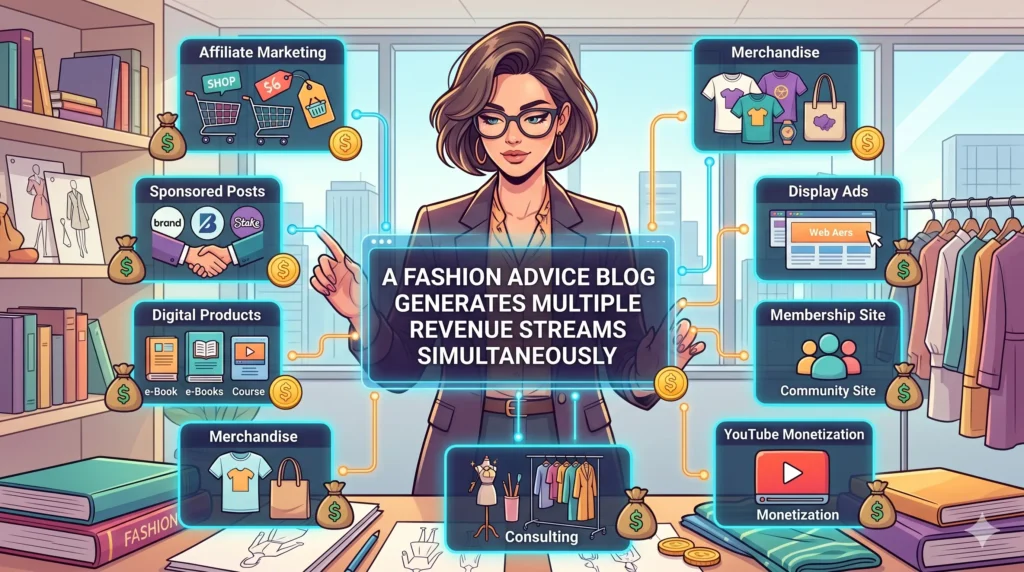
The monetization architecture of a fashion advice blog runs six distinct revenue channels, and the strongest operators stack all of them.
Fashion affiliate programs represent the fastest path to positive cash flow. Major fashion affiliate programs pay commissions ranging from 5% to 10% per facilitated sale. PrettyLittleThing’s affiliate program, for example, pays up to 10% per sale. A fashion advice blog generating 50,000 monthly readers and converting 2% through affiliate links at an average order value of $85 generates roughly $8,500 in monthly affiliate revenue — without manufacturing, holding inventory, or running customer service operations. That number scales linearly with traffic.
Sponsored content and brand partnership revenue unlock at meaningful traffic thresholds. A fashion advice blog with a targeted, engaged readership commands rates that dwarf display advertising CPMs. The data confirms this at category level: influencer and creator campaigns in fashion generate measurable returns for brands — 340% ROAS on Instagram product tagging, $7.16 customer acquisition costs via micro-influencer campaigns reaching 2.8 million users. A fashion advice blog that delivers that reach and engagement to brand partners captures those budgets directly instead of letting intermediary platforms take the margin.
Digital product revenue — style guides, wardrobe capsule templates, personal styling consultations, courses — scales with zero incremental production cost. Fashion advice blog operators running digital product lines treat every editorial post as top-of-funnel for a paid product that solves the next problem the reader faces. A post on “how to dress for a job interview” drives readers to a $97 capsule wardrobe guide. A post on “summer outfit formulas” drives readers to a seasonal styling course. The content-to-product funnel costs nothing beyond the original publishing investment.
The business logic: A fashion advice blog doesn’t have one revenue model. It has six running concurrently, and the traffic that powers all of them costs less per acquisition than any paid channel at scale.
A Fashion Advice Blog Captures High-Intent Search Traffic That Converts

A fashion advice blog occupies the highest-value position in organic search: informational and commercial intent queries that precede purchase decisions. When a consumer types “what to wear to a summer wedding 2026,” “how to style wide-leg trousers,” or “best sustainable fashion brands under $100” into Google, the fashion advice blog ranking at position one captures that click — and that reader — before any fashion ecommerce brand runs a retargeting ad against them.
The traffic math justifies the content investment directly. Roughly 39.8% of searchers click the first-page organic result, compared to 18.7% who click the second, according to FirstPageSage’s click-through rate research. A fashion advice blog ranking for 50 mid-volume style queries at 1,000 searches per month each generates 20,000 to 40,000 monthly organic visits with a content investment that, once made, costs nothing to maintain. The equivalent paid search traffic at a $1.50 average cost-per-click costs $30,000 to $60,000 per month — every month, indefinitely.
AI-powered search changes the calculus further in favor of a fashion advice blog. As AI shopping agents and generative search engines replace traditional keyword queries, the content that surfaces in AI-generated answers comes from sites with topical authority — sites that have published dozens of high-quality, interlinked posts on a specific subject. A fashion advice blog built on topical depth gets selected by AI systems as the authoritative source. A brand with three product pages and a sparse blog does not. Strategy& / PwC’s 2026 Fashion Retail Outlook confirms that 25% of German and Austrian consumers already buy fashion directly through AI assistants — and those AI systems pull recommendations from sites they trust, not from ad budgets.
Google’s own spring 2026 trending search data reveals the volume of fashion advice intent: “silk scarf styling” at all-time search highs, “how to wear Capri pants,” “best ballet flats 2026,” “lace midi skirt outfits” — all breaking search records in 2026. Every one of those queries represents a reader looking for a fashion advice blog to answer their question. Most niches remain underserved by high-quality editorial advice content, which means the competitive window to build authority remains open.
The business logic: A fashion advice blog captures purchase-intent search traffic at a fraction of paid search costs, and AI-driven discovery amplifies that advantage — because topical authority, not ad spend, determines which sources AI systems cite.
A Fashion Advice Blog Turns an Audience Into a Scalable Business Asset
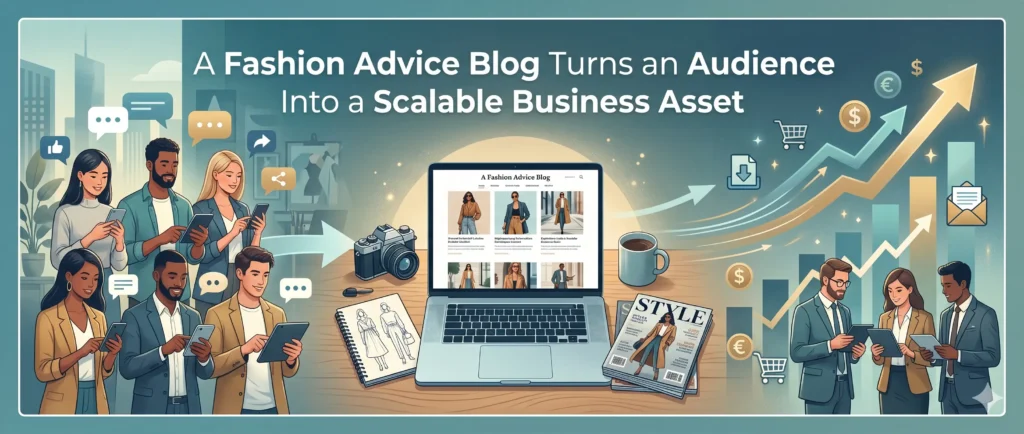
The fashion advice blog operators generating sustainable seven-figure businesses in 2026 treat their blog as audience infrastructure, not a content calendar exercise. That distinction determines everything.
Audience infrastructure means building an email list, a community layer, and a data asset from every visitor the fashion advice blog attracts. Email marketing delivers $42 in revenue for every $1 spent, according to 2026 content ROI benchmarks — the strongest return of any digital channel. A fashion advice blog with 30,000 subscribers and a monthly email sequence converts readers into repeat buyers, course enrollments, and brand partnership audiences that command higher rates than anonymous ad placements. Brands pay premiums to reach verified, self-selecting fashion audiences that a fashion advice blog assembles organically.
The social commerce integration layer amplifies that audience further. Social commerce will generate an estimated $919 billion globally in 2026, per Shopify’s ecommerce report. A fashion advice blog operating as a hub — with content syndicating to Instagram Reels, TikTok outfit breakdowns, and Pinterest style boards, all pointing back to the blog’s affiliate links and product offers — functions as a content flywheel. Each platform brings new readers into the blog’s orbit; the blog converts them into email subscribers; email converts subscribers into buyers.
Gen Z adds $2.7 trillion in annual spending to global markets. Eighty percent use social media for shopping discovery. Sixty-two percent prefer sustainable brands. A fashion advice blog that speaks directly to that consumer’s values — styling sustainable pieces, surfacing affordable alternatives to luxury looks, advising on how to build a wardrobe that lasts — builds an audience with purchasing power and high brand loyalty.
The business logic: A fashion advice blog doesn’t just drive traffic. It builds a first-party audience asset — email list, community, social following — that generates compounding revenue independent of algorithm changes, ad cost inflation, or platform shifts.
Build the Fashion Advice Blog Now, Before Your Category Fills Up
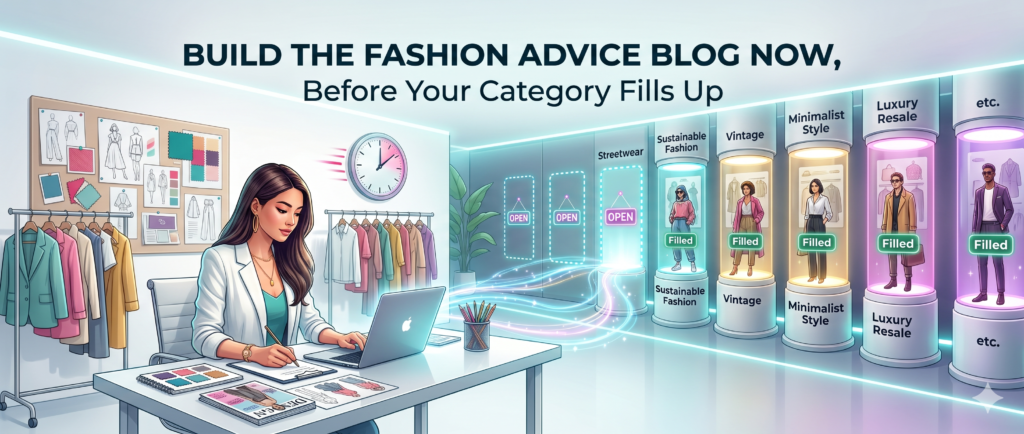
A fashion advice blog built on genuine expertise, topical depth, and consistent publishing compounds its authority every month — the brands and creators who start building now will own the organic and AI-driven discovery channels that their competitors will pay to reach in three years. The window closes as the category fills; the cost of waiting is measured in market share, not just missed traffic.