

The Money Heist series started as a failed regional TV show acquired for $2 and became a 2.2-billion-hour global franchise — and every strategic decision that made that possible maps directly onto how the best Series A companies build moats, retain users, and compound value from a single founding insight.
Money Heist Series is one of the most popular Spanish crime-thriller series that gained international attention because of its suspenseful storytelling, memorable characters, and unexpected twists. Money Heist Series originally premiered as La Casa de Papel and later became a global phenomenon through Netflix. The story of Money Heist Series revolves around a mysterious mastermind known as the Professor and a group of criminals who plan highly ambitious heists.
Story of Money Heist Series
The central story of Money Heist Series follows the Professor, who carefully brings together a team of specialists for a major robbery. Money Heist Series focuses on the group’s attempt to enter highly secured locations, manage hostages, overcome police operations, and execute complicated plans. The story of Money Heist Series becomes increasingly intense as the characters face unexpected challenges and conflicts.
The Professor in Money Heist Series
The Professor is one of the most important characters in Money Heist Series. Money Heist Series presents the Professor as an intelligent, strategic, and highly calculated planner who often stays several steps ahead of his opponents. His ability to anticipate problems is a major reason why the plans in Money Heist Series become so fascinating.
Money Heist Series Lesson One: The Best ROI Comes From Undervalued, Validated Assets

Netflix didn’t commission the Money Heist series. It acquired it when no one else wanted it.
La Casa de Papel debuted on Spanish broadcaster Antena 3 in May 2017. Viewership peaked early, then slipped below network targets. By the end of its first run, the show had lost commercial momentum and couldn’t justify continued domestic investment. Antena 3 needed international distribution it couldn’t finance. Netflix needed non-English content it hadn’t yet built. The deal closed for a reported $2 — a nominal licensing fee that gave Netflix global streaming rights to an already-completed, audience-tested, critically respected product.
Netflix then did four things fast: recut the Money Heist series from 15 episodes into 22 binge-optimized segments, renamed it in English, released it to its global subscriber base, and let its recommendation algorithm do the distribution work. Without a dedicated marketing campaign, the Money Heist series became the most-watched non-English-language show on Netflix within four months. By April 2018, it had surpassed Stranger Things — a show Netflix spent tens of millions creating and marketing — in streams across the US and worldwide.
The total production budget across all five seasons of the Money Heist series ran approximately $46 million. The franchise has since accumulated over 2.2 billion hours of watch time across all seasons and spin-offs, holds three entries on Netflix’s all-time top 10 list for non-English series, and ranks as the 10th most-watched property in Netflix’s entire catalog regardless of language. Viewing to non-English-language content including the Money Heist series has grown from less than one-tenth to a third of all Netflix viewing over the past decade.
That asymmetry — $2 acquisition cost, global category leadership — defines the ROI logic that the best Series A founders apply to product decisions. Don’t build what the market hasn’t yet validated. Find the product with proven audience love, no distribution infrastructure, and no international profile. Then become the distribution layer. The Money Heist series didn’t need Netflix to make it good. It needed Netflix to make it visible.
Founder translation: Before you build another feature, audit the partnerships, open-source projects, or underpriced acquisitions in your category that already have product-market fit. The fastest path to a $46M-to-billions ROI ratio is validated assets with broken distribution — not original bets on unproven concepts.
Money Heist Series Lesson Two: Niche Specificity Travels Farther Than Universal Appeal
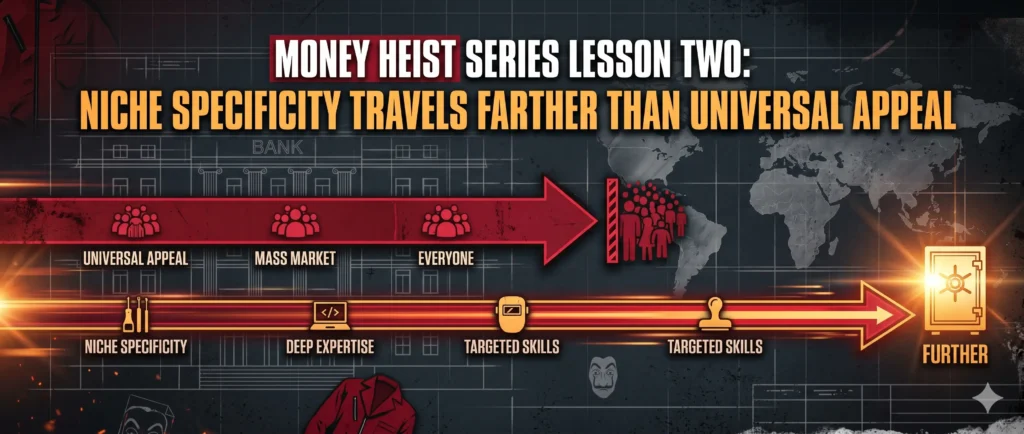
Every instinct in global content production points toward removing friction: simplify cultural references, neutralize regional specificity, cast for international recognizability. The Money Heist series did the opposite and dominated globally because of it.
The show’s setting in institutions of Spanish national identity — the Royal Mint, the Bank of Spain — gave it immediate dramatic stakes that audiences worldwide found viscerally legible without explanation. Its characters carried city names — Tokyo, Nairobi, Berlin, Denver — that mapped the crew across a global cultural geography and gave international audiences instant personal anchors. Its soundtrack built around “Bella Ciao,” an Italian partisan resistance anthem, added a layer of emotional and political resonance that crossed language barriers because it carried genuine historical weight, not engineered inclusivity.
Netflix proved the inverse of this lesson when it attempted to replicate the Money Heist series formula in South Korea with the 2022 adaptation Money Heist: Korea — Joint Economic Area. Netflix faced mixed reactions with Money Heist: Korea, which struggled to replicate the cultural phenomenon of the Spanish original despite strong initial curiosity — demonstrating that global success cannot be duplicated through localization alone. A second season was never commissioned.
The Dalí mask from the Money Heist series appeared at real-world protests in Chile, Hong Kong, Lebanon, and France — not because Netflix planned that outcome, but because the show’s anti-establishment narrative mapped onto genuine political frustrations across entirely different cultural contexts. That kind of earned cultural resonance produces organic distribution that no paid media budget replicates. Internationally produced hits like the Money Heist series often generate stronger global engagement relative to their production budgets than expensive English-language originals.
Founder translation: Build for a specific user’s real problem, in their real context, with their actual vocabulary. Generic positioning competes on price. Specific positioning builds moats. The Money Heist series won globally by being maximally Spanish — and the companies winning in vertical SaaS, niche marketplaces, and category-specific tools win by the same logic.
Money Heist Series Lesson Three: IP Compounds — Ship the Sequel Into the Original’s Architecture

The Money Heist series finale aired in December 2021. Netflix confirmed in May 2026 — four and a half years later — that the franchise is actively expanding. That timeline isn’t nostalgia. It’s a deliberate compounding strategy that every technical founder building a product ecosystem should study.
Three seasons of the original Money Heist series currently rank inside Netflix’s all-time top 10 for non-English TV, with 1.3 billion hours watched and around 160 million views for the main show alone. The Berlin spin-off — a prequel series built around the franchise’s most morally complex supporting character — premiered in December 2023 and opened as Netflix’s most-watched series globally in its premiere week, reaching the top 10 in 91 countries and holding a position in the non-English global top 10 for seven consecutive weeks. Berlin Season 2, officially titled Berlín y la dama del armiño, premiered globally on May 15, 2026.
Netflix confirmed the Money Heist universe expansion through a massive public event in Seville on May 9, 2026, with Álvaro Morte — who played the Professor in the original series — announcing the franchise’s continuation to a crowd watching red-jumpsuit-clad performers sail down the Guadalquivir River. Netflix released a teaser stating: “The revolution never ends.” Vancouver Media, the production company founded by Money Heist creator Álex Pina, is reportedly developing a four-episode mini-series centered on Colonel Tamayo — further expanding Netflix’s strategy of building individual stories around characters from the original heist drama.
The franchise architecture creates exactly what Netflix calls a retention engine: established IP that generates recurring viewership, reduces subscriber churn, and produces long-tail streaming value that experimental originals cannot match. Every new Money Heist series property reactivates the entire back catalog. New viewers discovering Berlin work backward through five seasons of the original. Back-catalog viewers generate fresh algorithmic recommendations. The ecosystem feeds itself forward and backward simultaneously.
Founder translation: The sequel belongs in the architecture of the original product. Every feature you ship should make the next product easier to sell to the same customer. Design retention into the structure — not as a growth hack added after launch, but as the mechanism the product runs on from the beginning.
Money Heist Series Lesson Four: Data-Driven Distribution Beats Marketing Spend

The Money Heist series reached its first mass global audience without a traditional marketing campaign. Netflix’s recommendation engine placed it precisely in front of viewers whose behavioral data predicted they would finish it — and completion rate was the metric that mattered most.
Netflix classifies content across over 80,000 microgenres to match shows to viewer preference profiles with a precision that traditional broadcast television never attempted. The Money Heist series performed across an unusually broad range of audience profile groups — a data signal Netflix’s content team identified before the international viewership numbers confirmed it. That cross-demographic completion pattern predicted geographic scalability, and Netflix amplified distribution into exactly the markets where completion signals were strongest.
The binge-watching architecture of the Money Heist series made it algorithmically ideal for Netflix’s engagement model. The narrative runs almost in real time across episodes — each one ending at a moment that makes stopping psychologically difficult. That structural decision, made by creator Álex Pina during scripting, produced the completion rates that drove algorithmic recommendation, which drove subscriber acquisition, which justified budget increases for subsequent seasons. After the Money Heist series exploded in popularity, Netflix commissioned new seasons and financed further production — the real financial relationship where meaningful money changed hands, built entirely on the data foundation of the original acquisition.
Part 3 of the Money Heist series reached 34 million household accounts in its first week of release. Part 4 broke numerous viewership records for non-English Netflix content, attracting 65 million households during its first four weeks. Those numbers didn’t come from a marketing budget — they came from a recommendation engine fed by behavioral data that proved the product worked before any promotional dollar was spent.
Founder translation: Build the product that your most engaged users cannot stop using. Instrument the completion metric — the equivalent of finishing an episode — and optimize distribution toward the cohorts that complete it fastest. Distribution amplifies product quality; it does not substitute for it. The Money Heist series taught Netflix that lesson in 2018, and the franchise’s 2026 expansion confirms they haven’t forgotten it.
The Money Heist Series Ran the Same Playbook the Best Startups Run — Execute It

The Money Heist series turned a $2 acquisition into a 2.2-billion-hour franchise by validating before building, staying specific to win broadly, engineering compounding into the product architecture, and letting behavioral data drive distribution at a scale no marketing budget could match. Every one of those decisions sits inside a playbook that Series A founders can execute starting today — the only question is whether you move before your category does.