
Women’s fashion trends move faster than any funnel you’ve ever built, and that speed is exactly why they deserve a line item in your competitive research.
Women’s Fashion Trends Are the Cheapest Market-Timing Data You’ll Ever Get
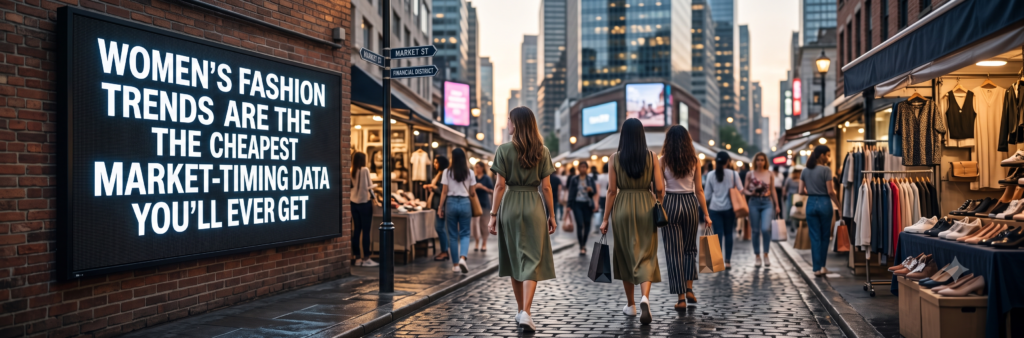
Most founders spend budget on surveys, focus groups, and analyst reports to figure out what consumers want next. Women’s fashion trends already answer that question, for free, in real time. A trend that spikes on resale platforms or search volume tells you what a specific demographic is willing to spend on before that demand shows up in your own funnel. Track women’s fashion trends the way you track competitor pricing, and you get a leading indicator instead of a lagging one. A DTC founder who watches women’s fashion trends for six months can spot a shift in spending behavior — from statement pieces to quiet, durable basics, for instance — months before it shows up in category-wide retail data. That gap is your window to reposition messaging, adjust inventory commitments, or reframe a paid campaign before your competitors catch up. Founders in adjacent categories, from fintech to logistics, can pull the same signal: women’s fashion trends reflect discretionary spending confidence at a granularity that GDP reports and consumer confidence indices simply don’t capture.
The mechanism is straightforward. Fashion cycles are short, visible, and heavily documented across search, social, and resale data. That makes women’s fashion trends one of the few consumer categories where you can measure sentiment shift week over week instead of quarter over quarter. If your product touches consumer spending in any way, ignoring women’s fashion trends means ignoring one of the fastest-updating datasets available to you.
Compare that update cycle to the tools most Series A teams already rely on. A quarterly NPS survey or an annual category report tells you where the market was, not where it’s heading. Women’s fashion trends give you the opposite: a rolling, high-frequency read on what a large, spending-active demographic is choosing right now. Set up a lightweight dashboard pulling search interest and resale listing volume for a handful of adjacent categories, and you’ve built an early-warning system that costs less than a single market research contract and updates faster than any report your team could commission.
Women’s Fashion Trends Reveal Real Willingness to Pay, Not Stated Preference
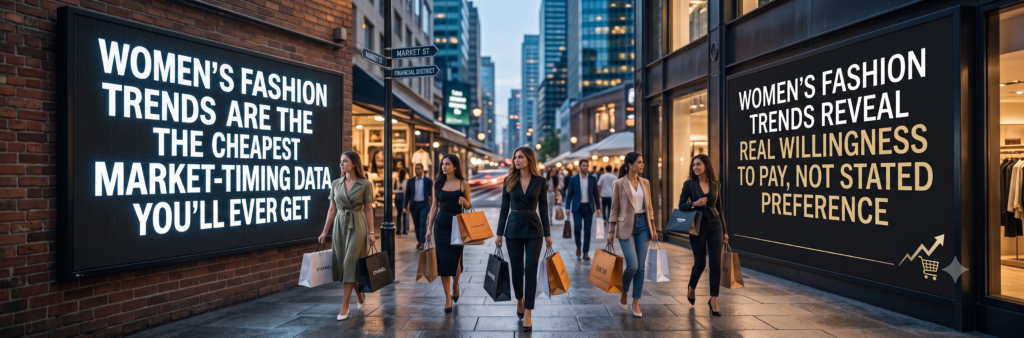
Surveys tell you what people say they want. Women’s fashion trends tell you what people actually paid for, in a category with notoriously thin margins and brutal competition. A brand that succeeds inside women’s fashion trends has already survived a pricing test that most SaaS products never face: a customer choosing to spend discretionary income on a non-essential item, with dozens of substitutes one click away. That’s a stronger signal of pricing power than almost any other category can offer.
Founders building in payments, buy-now-pay-later, or resale infrastructure already understand this instinct — companies like Afterpay and StockX built their early growth models on top of apparel spending, women’s fashion trends included, because apparel purchase frequency gave them enough transaction volume to refine risk models quickly. If you’re building anything that touches consumer credit, loyalty, or resale, the purchase behavior sitting inside women’s fashion trends is a faster proving ground than most B2B categories, simply because the sales cycle is measured in minutes, not months.
That transaction frequency matters more than founders usually give it credit for. A B2B sales cycle might generate a handful of pricing data points a quarter. A single week of activity inside women’s fashion trends can generate thousands of pricing decisions, across dozens of price points, from a single demographic. If you’re testing a new payment flow, a loyalty mechanic, or a dynamic pricing model, apparel spending gives you enough volume to reach statistical confidence in weeks instead of quarters — and the purchase patterns sitting inside women’s fashion trends are exactly where that volume lives.
Women’s Fashion Trends Compress Your Iteration Loop

Speed is the advantage every Series A founder is chasing, and women’s fashion trends operate on a design-to-shelf timeline that most industries can’t match. Fast-fashion players can move a trend from social feed to storefront in under three weeks. That’s not a fashion industry quirk — it’s a masterclass in tight feedback loops, and it’s worth studying even if you never sell a single garment.
Apply the same logic to your own roadmap. If a founder can observe how women’s fashion trends get tested, scaled, or killed in under a month, that founder has a template for running faster product experiments internally. The companies that dominate women’s fashion trends don’t wait for a full season to validate a design; they ship small batches, watch conversion, and scale winners within days. Compare that to a typical enterprise software team debating a feature for two sprints before shipping to five customers. The apparel industry’s relationship with women’s fashion trends is proof that a tight build-measure-learn loop isn’t theoretical — it’s operational reality for an entire multi-billion-dollar sector.
Women’s Fashion Trends Show You Where Underserved Niches Still Exist
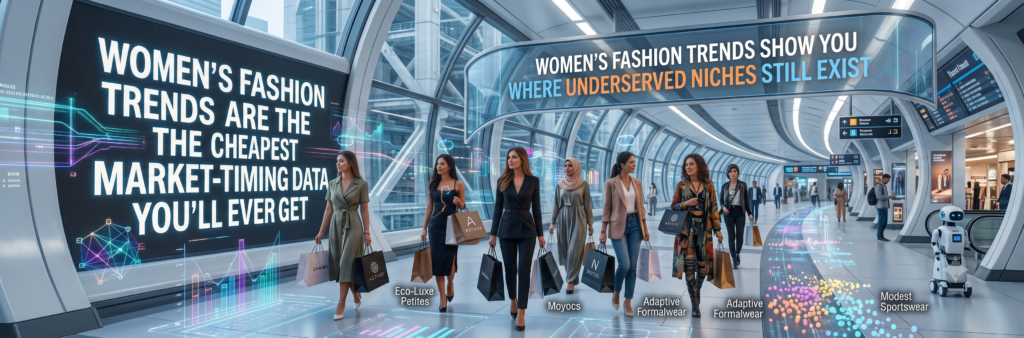
Every founder at Series A is hunting for a wedge — a niche large enough to build a business on but narrow enough that incumbents haven’t bothered defending it. Women’s fashion trends surface these wedges constantly, because trend cycles reward small, agile brands that can serve a specific aesthetic or body type faster than a legacy retailer can react. Adaptive clothing, size-inclusive activewear, and modest fashion all grew from niches that mainstream retailers ignored inside broader women’s fashion trends, until independent brands proved the demand and forced incumbents to follow.
That pattern isn’t unique to apparel. It’s a repeatable playbook: find the segment of women’s fashion trends that large players are underserving, build fast, and let purchase data validate the thesis before you scale spend. Founders outside fashion can borrow the exact same underserved-niche logic — the categories change, but the discipline of watching a fast-moving trend space for gaps is transferable to any consumer-facing product.
The founders who spot these gaps early aren’t relying on intuition alone. They’re running the same due diligence a Series A investor would expect on any market: sizing the niche, checking retention among early adopters, and confirming the segment can support a margin structure that scales. Women’s fashion trends just happen to make that diligence unusually fast, because the purchase signal is public, high-frequency, and cheap to observe compared to gated B2B data.
Treat women’s fashion trends as a live dataset instead of a lifestyle beat, and you get a faster, cheaper proxy for consumer behavior than most research budgets can buy. The founders who study this space aren’t chasing style — they’re stealing a shortcut on timing, pricing, and product velocity that most competitors never think to look for.